
The ancient Cha forest is poetic in the deciduous season
The ancient Cha forest is poetic in the deciduous season
Thua Thien – Hue Ru Cha mangrove forest in Huong Phong commune, Hue city is in the most beautiful season when thousands of ancient Cha trees lose their leaves, waiting for the day to bloom.

Thousands of ancient Cha trees located in the Ru Cha mangrove forest with an area of more than 5 hectares located on Tam Giang lagoon, opposite Thuan An estuary in Thuan Hoa village, Huong Phong commune are in the deciduous season, waiting for the day of flowering. This mangrove forest is about 10 km from the center of Hue City, which is a place visited by many people who love to explore nature.

These days, thousands of ancient Cha trees lose their leaves, creating a poetic scene like a European sky when snow falls and freezes the trees.
Cha tree is a tree that grows naturally in the brackish waters along the Tam Giang lagoon. This tree is woody, usually flowering in September, signaling the upcoming rainy season.

The dense population of Cha trees with pure white leaves is interspersed next to the green cork forest. The canals and ditches located in the Ru Cha mangrove forest are home to shrimp and fish.

The heat lasts for a long time, many areas in the Ru Cha mangrove forest are dry. Compared to every year, thousands of ancient Cha trees lose their leaves, waiting for the flower blooming day earlier.

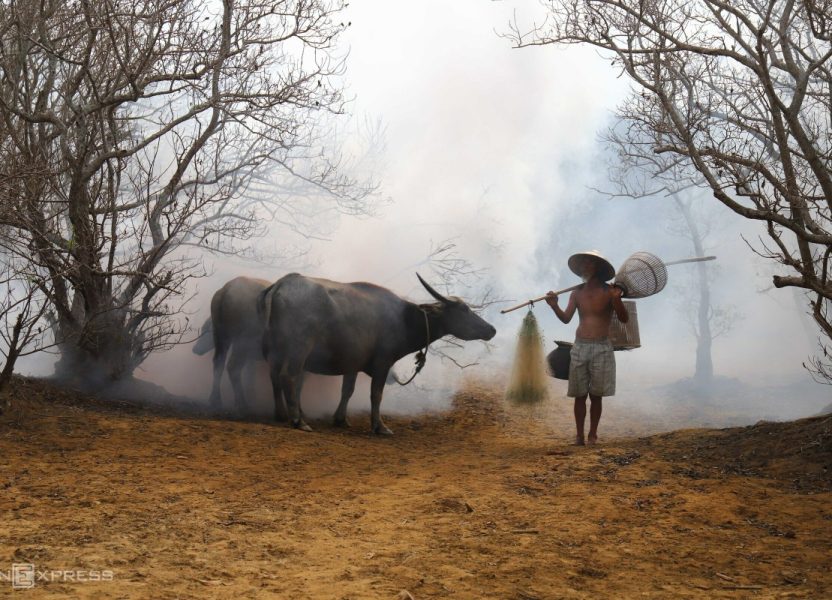
An old farmer in Thuan Hoa B village with a herd of buffaloes in the Ru Cha mangrove forest.
The scene of a herd of buffaloes grazing in the Ru Cha mangrove forest during the drought is sought out by many photographers.

With poetic scenery, but not selling tickets, in recent days, Ru Cha mangrove forest has been visited by many people to take pictures.

Some Cha trees have also started to bud waiting for the flowering date. Mr. Nguyen Ngoc Dap, 79 years old, who has lived with his wife for nearly 40 years in the Ru Cha mangrove forest, said that this year the Cha trees shed their leaves early, signaling that the rainy season may come earlier than every year. Every year, in September, the Cha tree usually blooms, but this year the Cha tree is likely to bloom in mid-July.

Over the years, the area around the Ru Cha mangrove forest has been planted with water coconuts and cork. According to the plan, the 187-hectare Con Te – Ru Cha mangrove forest zoning will be located in the Tam Giang – Cau Hai wetland nature reserve with an area of more than 2,000 hectares.

The Cha trees lose their leaves waiting for the day to bud and bloom. The flowers of the Cha tree are yellow, growing in short chains.

The population of pure white deciduous Cha trees is located in the middle of a water coconut forest. According to the planning of Hue City, in the future, Ru Cha mangrove forest will develop community tourism and nature conservation.
Source: VNExpress
Comments (0)